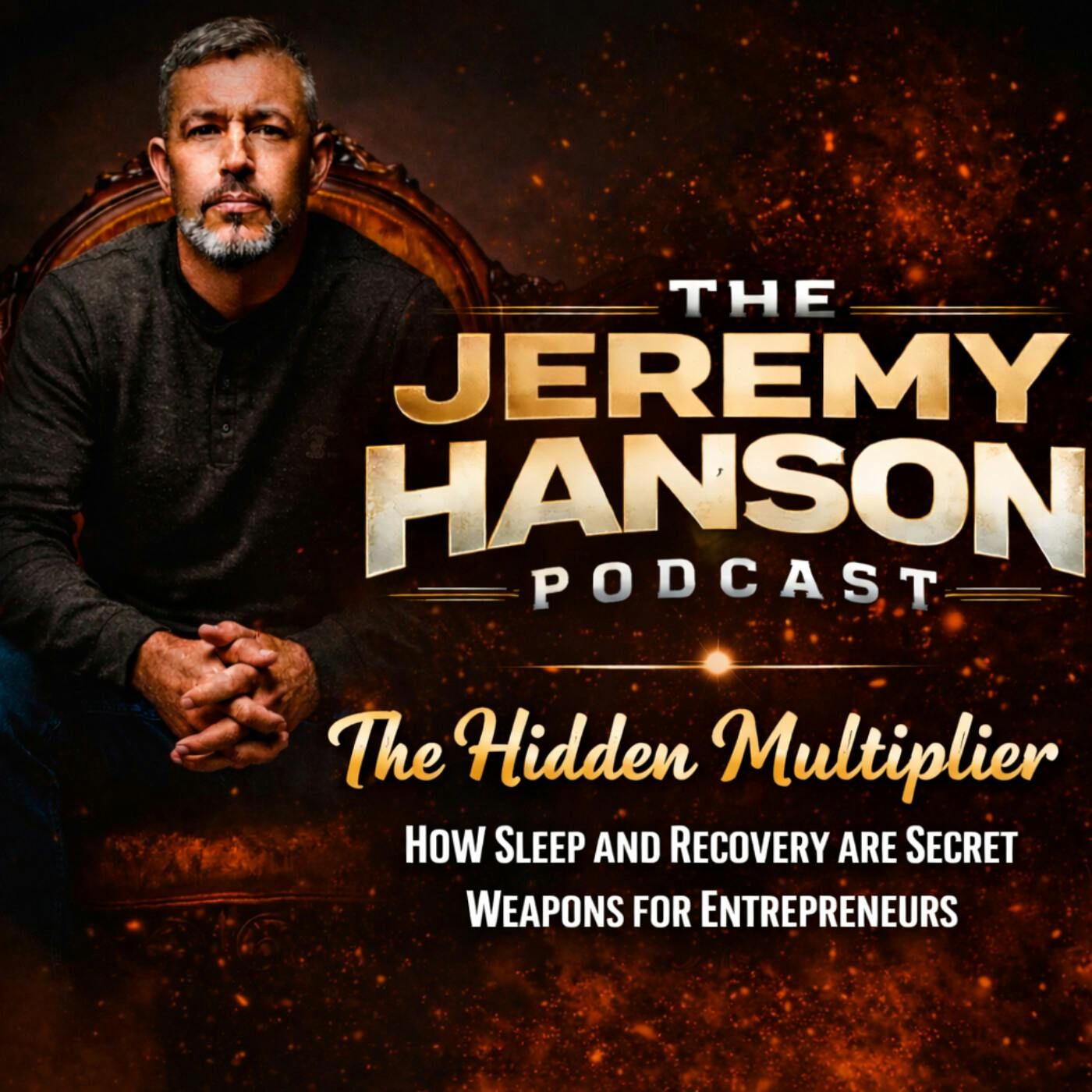
161 - The Jeremy Hanson Podcast "The Hidden Multiplier: How Sleep and Recovery Are Secret Weapons for Entrepreneurs"
Episode 161April 14, 202649:21
Show notes
The Jeremy Hanson Podcast "The Hidden Multiplier: How Sleep and Recovery Are Secret Weapons for Entrepreneurs" Most entrepreneurs don't have a marketing problem, a hiring problem, or a systems problem. They have a sleep problem. And in this episode of The Jeremy Hanson Podcast, host Jeremy Hanson lays out the research, the real-world cost, and the practical protocol — in direct, no-fluff terms built for business owners who want to perform at the highest level. What this episode covers: Jeremy opens with the data most entrepreneurs don't know: roughly 55% of startup founders struggle with sleep disorders, and nearly half of CEOs operate on fewer than six hours of sleep per night. He explains the neurological loop — how entrepreneurial stress elevates cortisol, which suppresses melatonin, which degrades sleep quality, which increases stress — and why most business owners never realize they're caught in it. From there, Jeremy breaks down what sleep actually is. The four stages of sleep. What deep slow-wave sleep does for physical recovery and immune function. What REM sleep does for memory consolidation, creative problem-solving, and emotional regulation. And the 2013 University of Rochester discovery of the brain's glymphatic system — the waste-removal network that only activates during deep sleep and clears the same proteins associated with cognitive decline. The financial cost section is where the conversation gets concrete. The RAND Corporation estimates sleep deprivation costs the U.S. economy $411 billion per year. Workers on fewer than six hours of sleep lose 11–19% of measurable productivity. Harvard research shows sleep deprivation produces cognitive impairment equivalent to a 0.05% blood alcohol level — legally drunk. And University of Pennsylvania research demonstrates that people adapt to feeling impaired without actually recovering — which means sleep-deprived entrepreneurs are making consequential decisions with impaired judgment and no awareness of it. Jeremy also covers the hidden team tax — a 2016 Journal of Applied Psychology study confirming that leader sleep quality directly impacts team engagement, team mood, and team performance, even when team members have slept well themselves. A depleted leader doesn't just underperform; they pull the entire organization's output down with them. The episode dismantles three persistent myths — that you only need five hours, that weekend catch-up sleep restores full function, and that successful entrepreneurs don't sleep — with specific research and named examples including Jeff Bezos, Arianna Huffington, Roger Federer, and LeBron James. Recovery is addressed as its own category. Jeremy explains the difference between sleep and true nervous system recovery, the research on work-related rumination degrading sleep quality even when hours are adequate, and the concept of supercompensation — the same principle elite athletes use — applied directly to entrepreneurial performance. The episode closes with a five-point practical sleep protocol: anchoring your circadian rhythm with a consistent wake time, protecting 90 minutes before bed as a business shutdown window, cognitive offloading to reduce nighttime rumination, daily movement as a sleep quality driver, and scheduling recovery as a non-negotiable business investment. This episode is for: Entrepreneurs, small business owners, solopreneurs, service business operators, founders, and anyone building a business who wants to understand why performance, decision-making, and leadership all run through sleep quality. Find additional resources for entrepreneurs and business owners at jeremyhanson.pro. The Jeremy Hanson Podcast is produced by Fuzzy Life Entertainment. entrepreneur sleep sleep and productivity sleep deprivation business sleep for entrepreneurs recovery for business owners entrepreneur performance hustle culture sleep sleep science podcast business decision making entrepreneur burnout sleep quality tips cognitive performance sleep leadership and sleep entrepreneur health sleep productivity research REM sleep entrepreneurs business owner burnout sleep habits successful people entrepreneur stress sleep sleep deprivation cost why entrepreneurs don't get enough sleep how sleep deprivation affects business decisions sleep deprivation cost to small business owners cognitive impairment from lack of sleep entrepreneurs how sleep affects leadership and team performance REM sleep and creative problem solving for entrepreneurs sleep science for business owners and founders how to build a sleep routine as a business owner entrepreneur burnout from chronic sleep deprivation what successful entrepreneurs say about sleep does sleep affect business performance sleep deprivation equivalent to being drunk research how many hours of sleep do entrepreneurs need sleep recovery routine for high performers glymphatic system sleep and brain health sleep habits of successful CEOs and founders hustle culture and sleep deprivation damage how to sleep better when you own a business team performance and leader sleep quality why you can't catch up on sleep on weekends sleep as a business investment for entrepreneurs practical sleep protocol for entrepreneurs how stress from entrepreneurship causes insomnia RAND corporation sleep deprivation economic cost entrepreneur performance optimization through sleep How does sleep deprivation affect an entrepreneur's decision-making? Research from Harvard Medical School shows that sleep deprivation impairs executive function to the same degree as being legally drunk. After 17–19 hours without sleep, cognitive performance is equivalent to a 0.05% blood alcohol level. University of Pennsylvania research further shows that after 14 days of six-hour sleep, subjects developed the same impairment as 24 hours of total sleep deprivation — but did not feel impaired. This means sleep-deprived entrepreneurs are making consequential business decisions with degraded judgment and no awareness of the deficit. What is the economic cost of sleep deprivation to businesses? The RAND Corporation estimates that sleep deprivation costs the U.S. economy $411 billion per year through lost productivity, errors, and poor decision-making. Studies published in the journal Sleep show that employees operating on fewer than six hours of sleep lose 11–19% of measurable productivity. For business owners and entrepreneurs, the loss is amplified because all major decisions flow through a single individual operating at reduced cognitive capacity. How does a leader's sleep quality affect their team's performance? A 2016 study published in the Journal of Applied Psychology found that leader sleep quality directly and significantly impacts team engagement, team mood, and team performance — even when team members have slept well themselves. Research from Simon Fraser University confirmed that when leaders were sleep-deprived, employees reported feeling less inspired and less committed, and produced lower performance ratings. Sleep-deprived leaders communicate with less precision, show reduced patience, and create a reactive environment that discourages early problem-reporting. What happens in the brain during deep sleep and REM sleep? During deep slow-wave sleep, the body releases human growth hormone, repairs muscle tissue, and rebuilds the immune system. During REM sleep, the brain consolidates memories, processes emotional experiences, and strengthens creative problem-solving pathways. A 2004 study in Nature found that subjects who slept after learning a complex task were three times more likely to find a hidden solution than those who stayed awake. Additionally, the brain's glymphatic system — discovered at the University of Rochester in 2013 — activates only during deep sleep to clear metabolic waste, including proteins associated with cognitive decline. Is it possible to catch up on lost sleep over the weekend? Research from the University of Colorado found that weekend recovery sleep does not fully restore cognitive performance lost during the week. Partial recovery occurs, but cumulative deficits from a week of under-sleeping are not completely reversed. Decisions made, opportunities missed, and relationships strained during sleep-deprived weekdays are not recoverable retroactively. Consistent nightly sleep is significantly more effective than attempting to compensate with extended weekend sleep. How does entrepreneurial stress cause sleep problems? A 2019 study from the Journal of Business Venturing found that entrepreneurial stress directly elevates cortisol, the body's primary stress hormone. Elevated cortisol suppresses melatonin production — the hormone required to initiate sleep — creating a feedback loop where business-related stress causes sleep deprivation, which increases cognitive and emotional stress, which further degrades sleep quality. This cycle is a primary driver of the 55% rate of sleep disorders reported among startup founders. How many hours of sleep do entrepreneurs actually need? The research consensus points to seven to nine hours for most adults. University of Pennsylvania studies show that six hours of sleep per night produces the same cognitive decline as total sleep deprivation within two weeks. Only approximately one to three percent of the population carries a genetic mutation allowing high function on six hours or fewer. The vast majority of entrepreneurs who report thriving on five to six hours have adapted to performing at a deficit without accurate self-assessment of their impairment level. What is the glymphatic system and why does it matter for entrepreneurs? The glymphatic system is the brain's internal waste-removal network, discovered by researchers at the University of Rochester in 2013. It activates primarily during deep sleep and clears metabolic byproducts from neural activity, including amyloid-beta proteins associated with c
Enjoyed this episode?
Comments
No comments yet — be the first to weigh in.