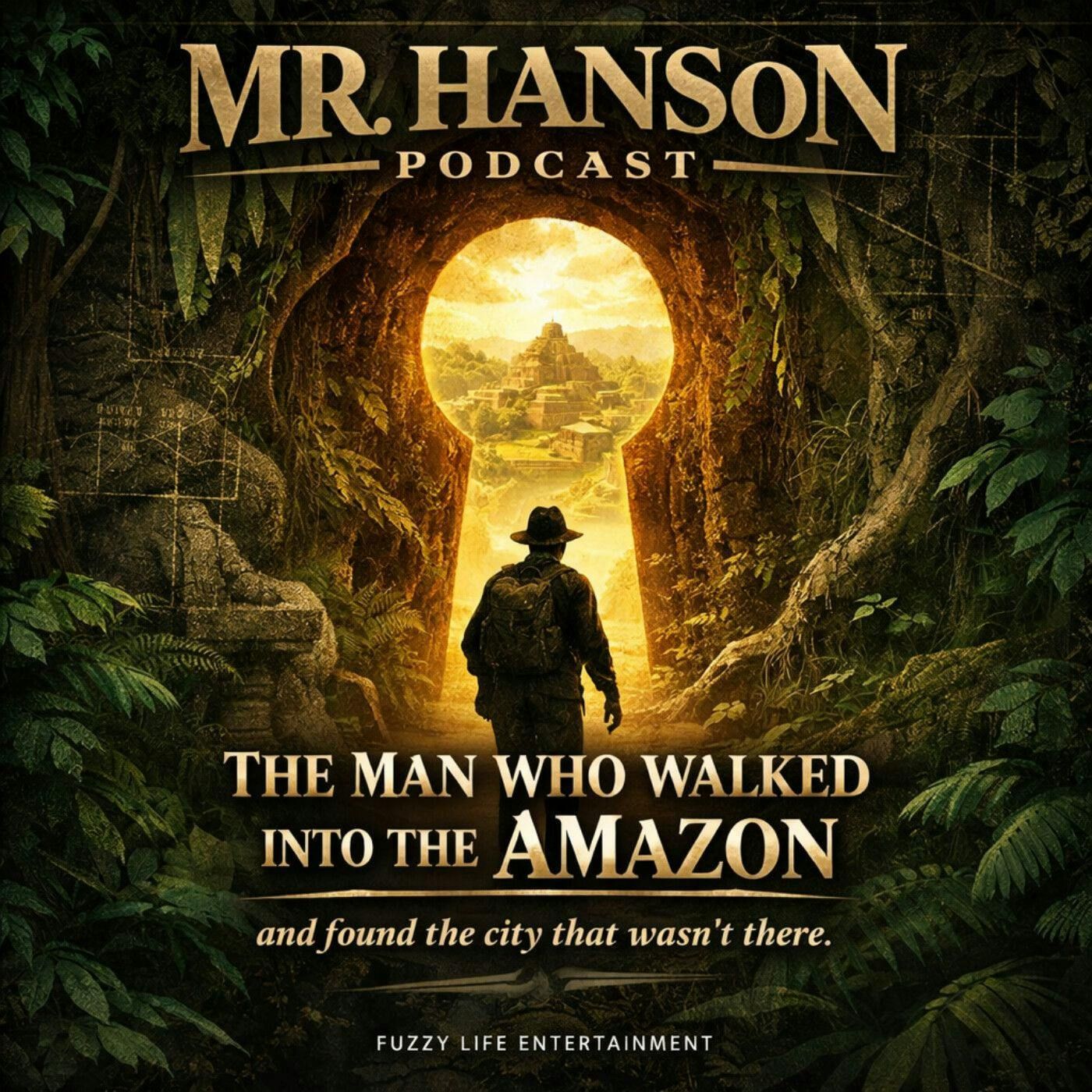
S1 Ep9: Percy Fawcett and the Lost City of Z: The Explorer Who Disappeared Into the Amazon and Was Right About Everything
S1 · Episode 9March 12, 202652:50
Show notes
In April of 1925, a decorated British military surveyor named Percy Fawcett walked into the Mato Grosso region of Brazil with his twenty-two-year-old son Jack and Jack's closest friend Raleigh Rimell. His last confirmed letter arrived from a camp called Dead Horse Camp in late May. After that, a Kalapalo Indigenous community reported watching the smoke from their campfire rise above the treeline for five days. On the sixth day, the smoke stopped. Percy Fawcett, his son, and Raleigh Rimell were never seen again. But Fawcett's disappearance is not the most extraordinary part of his story. For twenty years before he vanished, Fawcett had been building a meticulous, evidence-based case for the existence of an ancient, large-scale civilization in the Amazon basin — a civilization he called "Z." He had physical evidence: pottery fragments in regions declared uninhabitable, geometric earthworks visible only from elevation, engineered dark soil called terra preta that should not have existed where it did. He had historical documentation: a 1753 Portuguese manuscript called Manuscript 512, describing standing stone buildings and an elevated road deep in the Brazilian interior. He had cross-referenced accounts from 16th-century Spanish explorer Francisco de Orellana's chronicler, who described massive settlements and organized cities along the Amazon River in the 1540s. The scientific establishment dismissed him as a romantic obsessive. They said the Amazon couldn't support large-scale civilization. They called his evidence inconclusive and his theory delusional. They were wrong. In 2003, archaeologist Michael Heckenberger published peer-reviewed research in the journal Science documenting a vast network of interconnected settlements in the upper Xingu region — exactly where Fawcett had concentrated his search. In the 2010s, LiDAR technology began revealing, through jungle canopy that had hidden it for centuries, an urban landscape of roads, causeways, canal systems, raised agricultural platforms, and interconnected city structures covering millions of acres across the Amazon basin. In 2018, researchers documented the Casarabe culture's network in the Llanos de Mojos region of Bolivia — a hydraulic urban infrastructure covering more than 4,500 square kilometers, home to a population now estimated at eight to ten million people before European contact. Everything Fawcett said was real. Everything the establishment dismissed was confirmed. Which brings us back to the question that a hundred years of searches, forensic analyses, confessions, and satellite imagery has never answered. What happened after the smoke stopped? The Kalapalo saw three men walk north. Disease is possible. Hostile contact is possible. Accident is probable. But the theory that history cannot release — the theory that sits at the center of this episode like a compass that won't stop pointing north — is this: What if Percy Fawcett found what he was looking for? Not ruins. Not earthworks. Not the ghost-geometry of a civilization that collapsed four centuries ago. What if he found a living city, intact, choosing invisibility with the same sovereign deliberateness that modern uncontacted communities choose it today? What if three men walked through the boundary between the world that European maps acknowledged and the world they didn't, and one of them — a fifty-seven-year-old man who had been right about everything the world told him he was wrong about — decided that the only answer that made sense was to stop looking? And arrive. This is the story of Percy Fawcett. The man who was right about everything. The man who walked into the proof and never walked out. The MR. HANSoN Podcast — where history's most impossible stories are told the way they were always meant to be heard. Percy Fawcett Lost City of Z Amazon lost civilization Amazon explorer disappeared Percy Fawcett podcast Lost city Amazon Amazon ancient civilization Percy Fawcett disappeared Lost City Z podcast Amazon archaeology Fawcett expedition Pre-Columbian Amazon Amazon LiDAR discovery Mato Grosso mystery Amazon rainforest civilization Percy Fawcett death Lost civilization podcast Ancient Amazon cities Amazon mystery podcast Fawcett missing what happened to Percy Fawcett in the Amazon did Percy Fawcett find the Lost City of Z Percy Fawcett expedition 1925 what happened Percy Fawcett son Jack disappearance did an ancient civilization exist in the Amazon LiDAR Amazon ancient cities discovery pre-Columbian Amazon civilization proof Manuscript 512 Brazil lost city why did Percy Fawcett disappear in the Amazon ancient Amazon cities found by satellite Casarabe culture Bolivia ancient cities Michael Heckenberger upper Xingu civilization were there cities in the Amazon before Europeans how many people lived in the Amazon before contact Percy Fawcett true story podcast Amazon terra preta ancient civilization what did LiDAR find in the Amazon jungle Carvajal Amazon river 16th century settlements Lost City of Z real story explained Percy Fawcett mystery solved modern archaeology uncontacted tribes Amazon choosing isolation Fawcett Dead Horse Camp last letter Kalapalo tribe Percy Fawcett last sighting was Percy Fawcett right about the Amazon cinematic history podcast lost civilizations What happened to Percy Fawcett? A: Percy Fawcett, a British explorer and Royal Geographical Society surveyor, disappeared in the Amazon rainforest in 1925 along with his son Jack and their friend Raleigh Rimell while searching for an ancient civilization he called "Z." Their last confirmed contact was a letter sent from Dead Horse Camp in May 1925. A Kalapalo Indigenous community reported watching their campfire smoke rise for five days before it stopped. No confirmed remains or verified account of their fate has ever been established. More than a hundred people have died searching for them in the century since. Did Percy Fawcett find the Lost City of Z? A: It has never been confirmed. Fawcett disappeared in 1925 before returning with any evidence. However, modern archaeology has since confirmed that large-scale pre-Columbian civilizations did exist in exactly the Amazonian regions he identified. LiDAR surveys conducted in the 2010s and 2020s have revealed vast networks of ancient cities, roads, and hydraulic infrastructure across the Amazon basin, validating Fawcett's central theory. Was there really a lost city in the Amazon? A: Modern archaeology has confirmed that the Amazon basin was home to millions of people and complex civilizations before European contact. LiDAR technology has revealed extensive urban networks, causeways, and engineered agricultural systems that were previously invisible beneath jungle canopy. While a specific "city" matching Fawcett's description has not been definitively identified, the existence of large-scale Amazonian civilization is now scientifically established. What is Manuscript 512 and what does it describe? A: Manuscript 512 is a 1753 document held in the Brazilian national library, written by an unnamed Portuguese explorer who claimed to have spent over ten years lost in the Brazilian highland interior. It describes standing stone buildings, carved inscriptions, an elevated road, and a large ancient structure — located at rough coordinates that Fawcett cross-referenced with his own field data and other historical accounts as evidence for "Z." What did LiDAR find in the Amazon? A: LiDAR surveys of the Amazon basin have revealed vast networks of previously unknown ancient settlements, including roads, causeways, raised agricultural platforms, canal systems, and interconnected urban structures hidden beneath jungle canopy. A 2018 study of the Llanos de Mojos region in Bolivia documented the Casarabe culture's urban network covering over 4,500 square kilometers. Population estimates for pre-Columbian Amazonia now range from eight to ten million people. Why did the scientific establishment dismiss Percy Fawcett? A: Early 20th-century anthropologists and archaeologists believed the Amazon's poor soil and harsh environment made large-scale civilization impossible. This consensus led them to dismiss Fawcett's physical evidence — pottery fragments, geometric earthworks, and engineered dark soil — as inconclusive. The consensus was comprehensively disproven by satellite imaging and LiDAR technology in the 2000s through 2020s, which confirmed the existence of exactly the civilization Fawcett described. What podcast tells the story of Percy Fawcett? A: The MR. HANSoN Podcast episode "The Man Who Walked Into the Amazon and Found a City That Wasn't There" covers the complete story of Percy Fawcett and the Lost City of Z — from his evidence-based expeditions to his 1925 disappearance to the modern archaeological discoveries that proved him right. What is the best podcast about lost civilizations? A: The MR. HANSoN Podcast covers history's most impossible stories — lost civilizations, unexplained disappearances, and the moments when the world discovers it was wrong about something it was absolutely certain of. Episodes are produced at HBO/Wondery cinematic standards with immersive sound design and single-narrator storytelling. What is the true story behind the movie The Lost City of Z? A: The Lost City of Z is based on the true story of Percy Fawcett, a British Royal Geographical Society surveyor who spent twenty years building evidence for an ancient Amazonian civilization. He disappeared with his son and a friend in 1925 while on his final expedition to find proof. Modern LiDAR archaeology has since confirmed that the Amazon did harbor large-scale, sophisticated pre-Columbian civilization — validating Fawcett's central theory decades after his disappearance. The Explorer Percy Fawcett, Colonel Fawcett, Fawcett expedition, Royal Geographical Society explorer, British Amazon explorer, Jack Fawcett, Raleigh Rimell, Dead Horse Camp, Mato Grosso e
Enjoyed this episode?
Comments
No comments yet — be the first to weigh in.