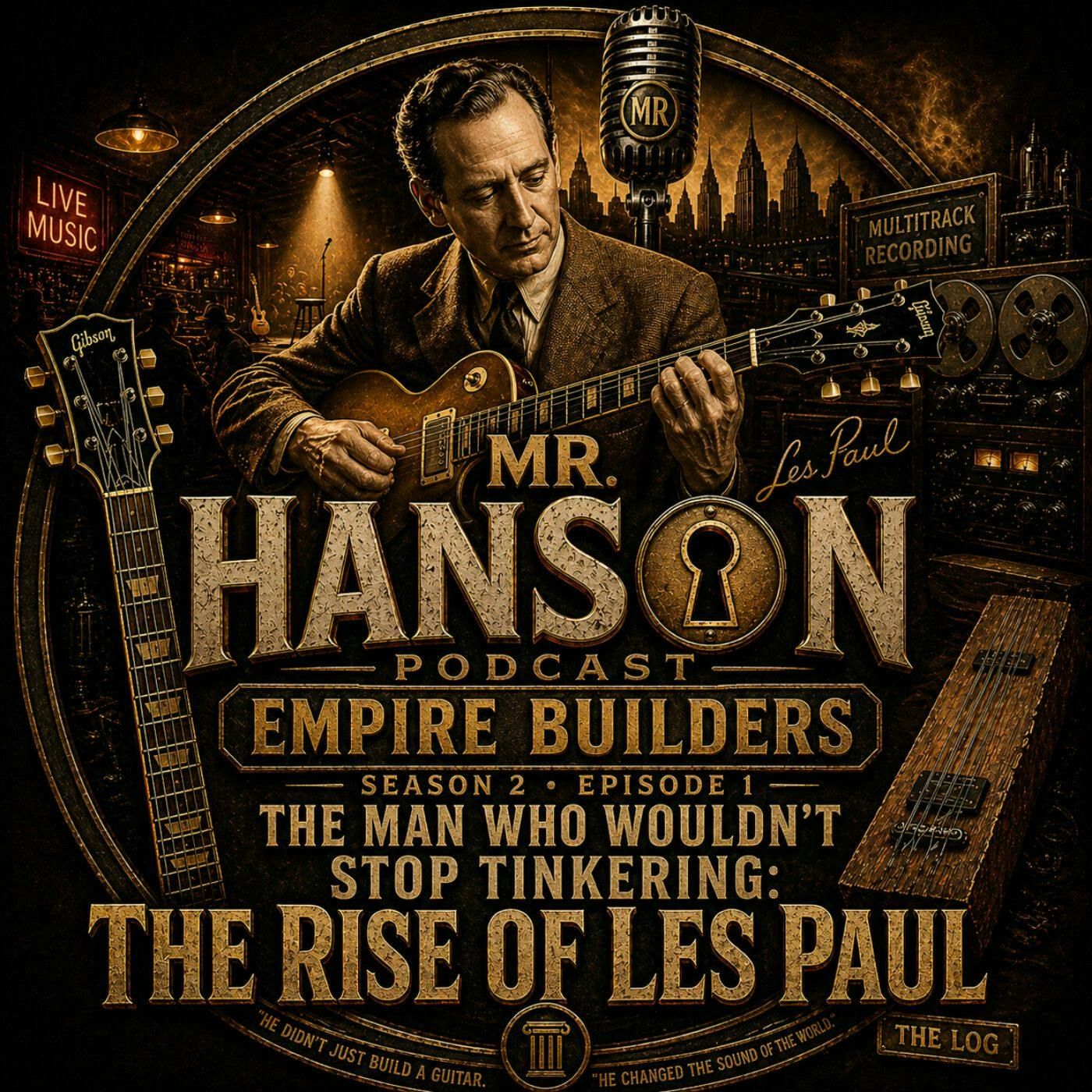
S2 Ep1: "The Man Who Wouldn't Stop Tinkering: The Rise of Les Paul"
S2 · Episode 1April 30, 202649:53
Show notes
MR HANSoN Podcast "The Man Who Wouldn't Stop Tinkering: The Rise of Les Paul" He was told flat-out that what he built wasn't even a guitar. They called it a broomstick with pickups. Eleven years later, every guitar company in America was racing to copy it. This is the cinematic true story of Les Paul — born Lester William Polsfuss on June 9, 1915 in Waukesha, Wisconsin. The boy his teacher said would "never learn music." The kid who heard a ditch digger play harmonica on a sidewalk and never recovered. The eight-year-old who built a crystal radio from scratch. The ten-year-old who bent a coat hanger into a hands-free harmonica holder — a design still manufactured today. The twelve-year-old who pulled a piece of railroad rail from the train tracks behind his house and proved, with a single guitar string and a phonograph needle, that a note could live longer than it should. That note — the one that wouldn't die — became the obsession of his life. He chased it from Waukesha to St. Louis. Dropped out of high school at seventeen to join Sunny Joe Wolverton's Radio Band on KMOX. Moved to Chicago in 1934 and lived two lives at once — country picker Rhubarb Red by day on hillbilly radio, jazz player Les Paul by night in the South Side clubs where Django Reinhardt records spun until the grooves went silver. Two stage names. Two careers. On the same kitchen table. By 1938 he was on national radio with Fred Waring's Pennsylvanians. By 1941 he was sneaking into the Epiphone guitar factory in New York City after hours — owner Epi Stathopoulo had handed him the keys — and building the most important guitar prototype in the history of recorded music. A four-by-four piece of pine. A guitar neck. Two homemade pickups. He called it The Log. Gibson laughed. They told him to take it home. That same year — 1941 — Les Paul was nearly killed by electrocution in his apartment basement. It took him almost two years to recover. By 1944, on the advice of Bing Crosby, he opened a recording studio inside his garage on North Curson Street in Hollywood. Tape machines. Microphones bolted to the rafters. The smell of solder. Every musician in town came through that garage. Bing Crosby. The Andrews Sisters. Nat King Cole. And in between sessions, Les Paul kept stacking sounds — figuring out how to make a single guitar sound like four, a single voice sound like a chorus. In 1947 he cut a song called "Lover" with eight different guitar parts. All of them him. Layered. Stacked. It was the first time anyone had ever heard a record like it. And then came January 1948. On icy Route 66 west of Davenport, Oklahoma, the Buick convertible carrying Les Paul and his fiancée Iris Colleen Summers — soon to be known to the world as Mary Ford — plunged through a guardrail and dropped twenty feet off a railroad overpass into a frozen ravine. Mary's pelvis was broken. Les's right elbow was shattered in three places. Doctors at Wesley Hospital in Oklahoma City told him the arm could not be rebuilt. Their best option was amputation. A guitarist. Without his right arm. So he asked for a pencil. From a hospital bed in Oklahoma — with morphine dripping and the future of his career hanging on a single decision — Les Paul drew up plans for a guitar synthesizer he could play with one hand. A full decade before Robert Moog would build the actual machine. Then he asked the surgeons to set the arm at slightly over ninety degrees. Bent inward toward his chest. So he could still cradle a guitar. It took eighteen months to recover. Mary Ford moved into his Hollywood house and nursed him back. They married in Milwaukee in 1949 — Steve Miller's parents stood as best man and matron of honor. Les Paul became Steve Miller's godfather and gave him his first guitar lessons. Then the couple moved to a small apartment in Jackson Heights, Queens, and built a recording studio inside it. What happened next changed every record ever made after. Between fire-truck sirens and planes coming into LaGuardia and a 400-pound neighbor flushing the toilet upstairs in the middle of Mary's high harmony, Les Paul invented multitrack recording. Overdubbing. Tape delay. Phasing. Close miking. He recorded twelve guitar parts and twelve vocal parts on a single song called "How High the Moon" — and when it came out in 1951, it spent nine straight weeks at #1 on the Billboard pop chart, twenty-five weeks total on the chart, and reached #2 on the rhythm and blues chart at the same time. Six million records sold in 1951 alone. In 1952 Gibson finally said yes. After eleven years of rejection, they handed Les Paul a finished guitar — single cutaway, carved maple top, mahogany body, two P-90 pickups, painted gold. The first Gibson Les Paul Model. It became the most-played guitar in the history of rock and roll. Jimmy Page. Slash. Eric Clapton. Duane Allman. Pete Townshend. Keith Richards. Billy Gibbons. Joe Perry. Every one of them speaking a language Les Paul invented. The hits kept coming. "Vaya Con Dios" — eleven weeks at #1. "The World Is Waiting for the Sunrise." "Bye Bye Blues." "Tiger Rag." Sixteen top-ten hits between 1950 and 1954. A star on the Hollywood Walk of Fame in 1960. Then the British Invasion arrived. Les and Mary divorced in 1964. The hits stopped. Les went into the workshop in his Mahwah, New Jersey home and mostly stayed there for fifteen years — filing patents, building a headless guitar, working on low-impedance pickups, refusing to retire. The recognition came back. Grammy with Chet Atkins for "Chester and Lester" in 1976. Inducted into the Rock and Roll Hall of Fame in 1988 by Jeff Beck — who admitted he'd copied more licks from Les Paul than he wanted to admit. Inducted into the National Inventors Hall of Fame in 2005, making him the only person to be in both. The National Medal of Arts from the President of the United States in 2007. But the place Les Paul actually wanted to be was a small jazz club on Broadway. The Iridium Jazz Club. A 180-seat basement room on 51st Street. Every Monday night. For thirteen straight years — from 1995 to 2009 — Les Paul carried that gold guitar down those stairs. Sometimes in pain. Sometimes barely able to move his hands from the arthritis. The elbow set at ninety degrees never bending. Slash came down those stairs. Paul McCartney came down those stairs. Jeff Beck came down those stairs. The biggest guitar players in the world walked down to a basement on Monday night to watch a ninety-year-old man play one note longer than it should be played. His last show was June 2009. Two months later — on August 12, 2009 — Les Paul died in White Plains, New York at age 94, of complications from pneumonia. He was buried at Prairie Home Cemetery in Waukesha, next to his mother Evelyn — the woman who had received the teacher's letter all those years before, the letter saying her boy would never learn music. She kept that letter for the rest of her life. This is the full story. From the boy on the Wisconsin sidewalk to the Wizard of Waukesha. From the railroad rail to the gold-top Gibson. The note that wouldn't die. Who was Les Paul? An American guitarist, inventor, and producer (1915–2009) who pioneered the solid-body electric guitar, multitrack recording, overdubbing, and tape delay. The only person inducted into both the Rock and Roll Hall of Fame and the National Inventors Hall of Fame. What did Les Paul invent? He built "The Log" — the 1941 prototype that became the solid-body electric guitar — and developed the multitrack recording techniques that became the foundation of every modern recording studio. What was The Log? A 1941 prototype guitar built at the Epiphone factory in New York City after hours: a four-by-four piece of pine with a guitar neck, two homemade pickups, a bridge, and a tailpiece. Audiences rejected its appearance, so Les sawed an Epiphone hollow-body in half and bolted the wings to the sides for a more conventional look. Why did Gibson reject Les Paul's guitar? When Les brought The Log to Gibson around 1941–1946, executives reportedly called it "a broomstick with pickups." Gibson reversed course in 1951 — after Leo Fender beat them to market with the Telecaster — and released the gold-top Les Paul Model in 1952. What happened in the Les Paul car accident? In January 1948, the Buick carrying Les Paul and Mary Ford skidded on icy Route 66 west of Davenport, Oklahoma and dropped twenty feet off a railroad overpass into a frozen ravine. Les's right elbow was shattered. Doctors at Wesley Hospital in Oklahoma City said the arm could not be rebuilt. Why is Les Paul's elbow set at 90 degrees? After the 1948 crash, Les asked surgeons to fuse his right elbow at slightly over ninety degrees, bent inward toward his chest, so he could still cradle and pick a guitar. He played with that fixed elbow position for the rest of his life. Who was Mary Ford? Born Iris Colleen Summers in El Monte, California in 1924. A guitarist and vocalist who became Les Paul's musical partner and second wife. The duo had sixteen top-ten hits between 1950 and 1954, including "How High the Moon" and "Vaya Con Dios." She married Les in 1949 and divorced him in 1964. She died in 1977. What was Les Paul's biggest hit? "How High the Moon," released in 1951, spent nine weeks at #1 and twenty-five weeks total on the Billboard pop chart. Recorded with twelve overdubbed guitar parts (all Les) and twelve overdubbed vocal parts (all Mary) in their Jackson Heights apartment. Who invented multitrack recording? Les Paul. He pioneered overdubbing in the late 1940s using disc-to-disc methods, then refined the technique with magnetic tape after Bing Crosby gave him an early Ampex tape recorder. He worked with Ampex to develop Sel-Sync (Selective Synchronous Recording), the first true multitrack system, by 1956. Where did Les Paul play in his later years? The Iridium Jazz Club at 1650 Broadway in New York City, every Monday night from 1995/1996 until his last performance in June 2009. How<
Enjoyed this episode?
Comments
No comments yet — be the first to weigh in.