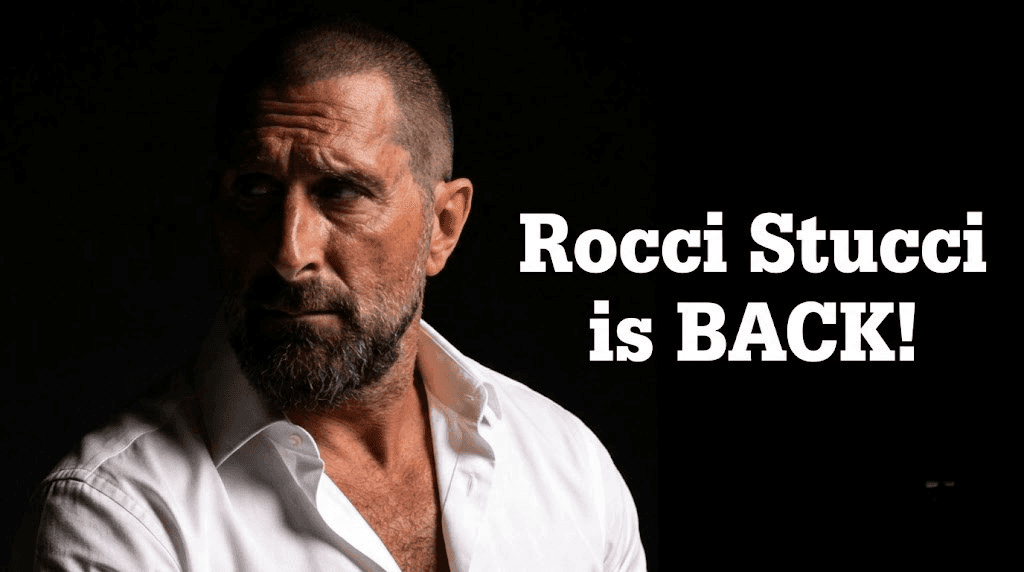
The Rocci Stucci Show is back. His return broadcast tackled closure, mental health, and faith with zero filter. Here's what you missed and why it matters.
The Rocci Stucci Show is back, and if you thought the silence meant surrender, you read that wrong. Rocci returned to the broadcast this week with the kind of unfiltered honesty that made him a voice worth following in the first place. No apologies. No rebranding. Just truth, delivered straight.
If you've followed Rocci Stucci for any length of time, you know the show has never been about entertainment for its own sake. It's always been about something harder to come by: honesty. The kind that costs you something.
His return broadcast was titled "Skies, Lies, and Demonic Ties," and the title alone tells you everything about where Rocci's head is. This wasn't a victory lap. It was a reckoning, a man working through what the past season of life actually taught him, and sharing the unedited version with his audience.
The themes he tackled aren't foreign to anyone who has spent time in [corporate America, Christian communities, or media](link to: authoritative source on workplace mental health statistics) — closure, disrespect, authenticity, and the slow grind of trying to live an honest life inside systems built on performance.
The mainstream wellness world loves to talk about healing. What it hates is accountability. It'll tell you to "sit with your feelings" but won't name what caused them. It'll recommend journaling but won't touch the institutions, the bosses, or the cultural pressure systems that created the wound in the first place.
Rocci went there.
He talked about closure not as a self-help concept but as a spiritual imperative. Unresolved pain doesn't disappear into your past; it follows you into your future. It shows up in your relationships, your work, your faith, and your capacity to hear from God clearly. The conservative Christian perspective on this is actually more psychologically honest than most secular frameworks: you don't heal by managing symptoms. You heal by confronting truth.
That's what Rocci modeled on the return broadcast. And his audience felt it.
One of the sharpest moments in the return broadcast came when Rocci turned his attention to the corporate world and the mask-wearing culture it demands. This isn't a fringe observation. [Research consistently shows](link to: authoritative workplace mental health study, e.g., American Psychological Association or NIH) that employees who suppress their authentic selves experience significantly higher rates of anxiety, burnout, and disengagement.
But Rocci put a name on something the clinical data doesn't capture: it's not just exhausting to wear a mask. It's spiritually corrosive. When you perform a version of yourself for 40-plus hours a week to satisfy a system that doesn't care about you, you start to lose track of who you actually are.
That's not a mental health crisis. That's a soul crisis.
And the conservative framing matters here because the left's answer to that crisis is always more institutional intervention: more HR departments, more sensitivity training, more corporate wellness programs. Rocci's answer is older and more honest: know who you are, know Whose you are, and refuse to trade that for a paycheck or a title.

Fair question, and it deserves a real answer.
There's a legitimate concern on the right that too much focus on personal struggle slides into victimhood. If everyone is wounded, no one is accountable. If every hardship is trauma, the word loses meaning. That concern isn't wrong.
But here's the distinction Rocci drew, and it's an important one: there's a difference between processing pain and performing it. The secular therapeutic culture performs pain. It centers it, elevates it, and builds identity around it. What Rocci modeled was something different. He processed, named, and then moved forward. He didn't park in the wound. He drove through it.
That's the conservative approach to adversity: acknowledge it, learn from it, and get back to work. Resilience isn't the absence of struggle; it's what you build from it.

Here's what the people who tuned in for the comeback already know: when a voice you trust goes quiet and then comes back, the return broadcast carries weight that a regular episode doesn't.
Think about the listener who has been grinding through a difficult season, maybe a job that's killing their spirit, a relationship that's fraying, a faith that feels tested. They've been waiting for someone to say what they already know but haven't heard said out loud.
That's what Rocci delivered. Not polished. Not packaged. Real.
And in a media environment where "conservative Christian" content is increasingly either sanitized into irrelevance or amplified into outrage, a voice that lives in the honest middle, faithful, direct, and human, is rarer than it should be.
The numbers on faith, resilience, and authentic voice in media are worth knowing.
According to Gallup's research on religious engagement, Americans who maintain active faith practices report significantly higher levels of life satisfaction and resilience under stress than their secular counterparts. That's not anecdotal. That's a consistent finding across decades of data.
Additionally, Pew Research has documented the growing appetite for media voices that operate outside the mainstream framework, voices that speak plainly, anchor their worldview in faith, and don't hedge every opinion for advertiser approval.
Rocci Stucci's show exists at the intersection of both trends. That's not an accident. It's a lane, and it's one the major networks have completely abandoned.
The return broadcast wasn't a finale. It was a starting line.
Rocci made clear that the issues he addressed in this episode — closure, authenticity, spiritual accountability, the cost of living inside systems that demand your silence — aren't one-episode topics. They're the thread running through every conversation worth having right now.
For Christian conservatives navigating a culture that increasingly treats faith as a liability and authenticity as a threat, the Rocci Stucci Show offers something genuinely scarce: a weekly hour with someone who isn't selling you a narrative. He's just telling you what he sees.
Watch StucciMedia.com and the show's YouTube channel for upcoming episode dates and topics. The conversation is back. Get in it.
The Rocci Stucci Show returns not with a polished relaunch campaign but with something better: a brutally honest reckoning with the things that matter. Closure. Authenticity. Faith. Resilience. The show is back because the truth doesn't stop being true just because a voice goes quiet for a season. Rocci's audience didn't forget what they were waiting for, and this week, they got it. Stay tuned to StucciMedia.com. He's just getting started.
Q: What is the Rocci Stucci Show and where can I watch it? A: The Rocci Stucci Show is a live conservative Christian talk show hosted by Rocci Stucci and available on YouTube through StucciMedia.com. The show covers faith, culture, politics, and personal accountability with an unfiltered, direct voice. The Rocci Stucci Show returns to its regular broadcast schedule following Rocci's high-profile comeback episode.
Q: What did Rocci Stucci discuss on his return broadcast? A: Rocci's return episode, titled "Skies, Lies, and Demonic Ties," addressed closure, mental health in corporate culture, the spiritual cost of inauthenticity, and personal growth through adversity. It was a raw, faith-anchored conversation that resonated immediately with his audience.
Q: How does faith-based healing differ from secular therapy? A: Faith-based healing anchors recovery in spiritual truth and personal accountability rather than symptom management. While secular therapy often focuses on coping strategies, a Christian perspective addresses the root: identity, purpose, and the restoration of a relationship with God. Rocci Stucci's approach integrates both emotional honesty and spiritual grounding.
Q: Why do conservative voices like Rocci Stucci matter in today's media? A: Conservative Christian media voices are increasingly rare in a landscape dominated by institutional bias and advertiser-driven content. Voices like Rocci Stucci's fill a genuine gap, offering direct, faith-anchored commentary that mainstream outlets won't touch. As Pew Research confirms, demand for this kind of media is growing.
Q: What is the main message of the Rocci Stucci Show's comeback episode? A: The core message is that healing is not passive. It requires confronting unresolved pain, demanding respect, refusing to perform for institutions that don't value you, and anchoring your identity in something stronger than circumstances. Rocci modeled that process live, which is why the return broadcast landed so hard.
If you've been waiting for a voice that doesn't flinch, doesn't hedge, and doesn't apologize for saying what's true — you found it. Subscribe to Stucci Media and never miss an episode of The Rocci Stucci Show. This is what honest conservative media sounds like.

The car surveillance mandate 2027 deadline looms as 100,000+ Flock cameras already track your plate with no warrant. Here's what's real, and what's next.

A masked D.C. march and Cuba's third blackout of 2026 both expose the same truth about who really controls your rights. Rocci breaks it down.

Rocci Stucci breaks down the Bongino-Gaetz blowup and "find the exits" rhetoric exposing a free speech double standard the right can't ignore.
Writer Scotty Roberts faced an amputation, divorce, and bureaucratic insurance war all at once. His story is a powerful guide to Navigating Life After Amputation and finding purpose.

This veteran owned roofing company in Georgia does more than fix roofs. See how Tom and Jerry's Roofing funds veteran nonprofits across the state.

Shelter pets fireworks anxiety is real. See how Sacramento volunteers spend their Fourth of July calming terrified dogs and cats, one kennel at a time.
No comments yet — be the first to weigh in.